
x

Market Holidays Click Here

EUR/USD Price Forecast: Remains sideways near 200-day EMA, ECB warns of high inflation

  • EUR/USD trades sideways around 1.1600 as investors await Iran’s reply to Trump’s 15-point proposal.
  • Trump’s 15-point proposal restricts Iran from building nuclear weapons.
  • ECB’s Lane said market dynamic suggests a price-level jump.

The EUR/USD pair trades broadly sideways around 1.1600 during the European trading session on Wednesday. The major currency pair consolidates as investors await Iran’s response to United States (US) President Donald Trump’s proposals of a month-long ceasefire and 15-point settlement plan.

US President Trump’s attempts of ceasefire have improved investors’ risk appetite. As of writing, S&P 500 futures are up almost 1%, reflecting strong demand for riskier assets. Meanwhile, the US Dollar (USD) trades calmly, with the US Dollar Index (DXY) trading in a confined range above 99.00.

On late Tuesday, US President Trump sent a 15-point proposal to Iran, which restricts the nation from pursuing nuclear ambitions and nuclear weapons, and disallows uranium enrichment on Iranian territory.

In the Eurozone, European Central Bank (ECB) officials have warned of upside inflation risks amid surging energy prices due to the war in the Middle East. “The market dynamic suggests a price-level jump,” ECB Chief Economist Philip Lane said.

EUR/USD technical analysis

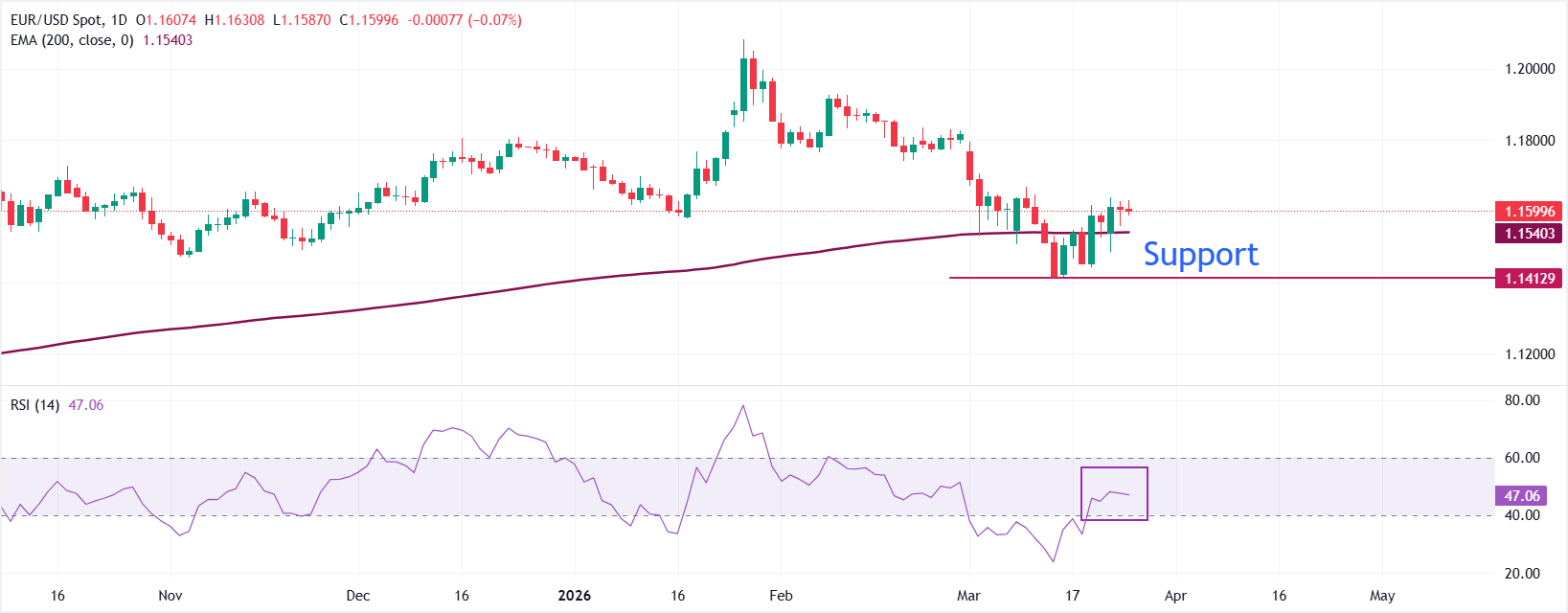
EUR/USD trades flat at around 1.1600 as of writing. The near-term bias is neutral with a mild downside tone as spot hovers just above the flattening 200-day Exponential Moving Average near 1.1540, which has lost upside inclination and now acts more as a directional pivot than a trending guide.

The 14-day Relative Strength Index (RSI) at 47 stays below the 50 line and confirms softening demand rather than outright bearish pressure, keeping the pair in a consolidative phase around its medium-term mean.

Immediate support emerges at 1.1540, where the 200-day EMA converges with recent reaction lows, and a daily close below this level would open the way toward 1.1510 and then the March 13 low of 1.1411. As long as 1.1540 holds on a closing basis, downside probes remain corrective within a broader range. On the topside, initial resistance stands at 1.1640, the last minor recovery high, followed by 1.1760 ahead of the 1.1835 barrier that has repeatedly capped advances.

(The technical analysis of this story was written with the help of an AI tool.)

(This story was corrected on March 25 at 10:59 GMT to say that the US Dollar Index (DXY) is trading in a confined range above 99.00, not 93.00.)

ECB FAQs

The European Central Bank (ECB) in Frankfurt, Germany, is the reserve bank for the Eurozone. The ECB sets interest rates and manages monetary policy for the region. The ECB primary mandate is to maintain price stability, which means keeping inflation at around 2%. Its primary tool for achieving this is by raising or lowering interest rates. Relatively high interest rates will usually result in a stronger Euro and vice versa. The ECB Governing Council makes monetary policy decisions at meetings held eight times a year. Decisions are made by heads of the Eurozone national banks and six permanent members, including the President of the ECB, Christine Lagarde.

In extreme situations, the European Central Bank can enact a policy tool called Quantitative Easing. QE is the process by which the ECB prints Euros and uses them to buy assets – usually government or corporate bonds – from banks and other financial institutions. QE usually results in a weaker Euro. QE is a last resort when simply lowering interest rates is unlikely to achieve the objective of price stability. The ECB used it during the Great Financial Crisis in 2009-11, in 2015 when inflation remained stubbornly low, as well as during the covid pandemic.

Quantitative tightening (QT) is the reverse of QE. It is undertaken after QE when an economic recovery is underway and inflation starts rising. Whilst in QE the European Central Bank (ECB) purchases government and corporate bonds from financial institutions to provide them with liquidity, in QT the ECB stops buying more bonds, and stops reinvesting the principal maturing on the bonds it already holds. It is usually positive (or bullish) for the Euro.

News

FXStreet global market news with bilingual coverage.

谈判还是备战?美国15点方案递到伊朗面前,双方距离协议有多远

根据截至2026年3月25日的最新信息,美国通过巴基斯坦向伊朗提交了一份包含15点要求的停火方案,并提出停火一个月以便谈判。但与此同时,美军也在向中东增派海军陆战队和空降兵部队。目前"球在伊朗一边",但德黑兰方面态度强硬,不仅否认与美方有任何谈判,其军方更直言"美国没资格谈判"。综合来看,伊朗接受当前方案并达成协议的可能性较低,美方"以谈备战"或为后续升级找借口的可能性较大。

美元/印度卢比回调,中东停火希望支撑风险偏好情绪

印度卢比(INR)周三早盘兑美元(USD)小幅上涨,美元/印度卢比货币对从前一日创下的94.75历史高点回落至94.30附近。随着美国寻求与伊朗达成为期一个月的停火协议并提出15点协议方案,油价承压,印度货币暂时获得支撑,显示出这场持续三周多的战争出现了实质性降级迹象。此外,路透社报道称,印度央行可能已出手干预以支持印度卢比。

欧洲央行:对能源冲击的二次效应采取观望态度 – 道明证券

道明证券指出,拉加德行长利用欧洲央行及其观察者会议阐述了管理委员会如何评估中东冲突冲击。该行表示,欧洲央行实际上是在争取时间,关注销售价格预期和工资跟踪指标。如果通胀持续偏离,可能会采取强有力的应对措施,但道明证券仍预计加息将推迟至2026年底。

英国央行(BOE):战争驱动的通胀前景重塑利率路径——野村证券

野村全球市场研究团队指出,英国2月份CPI通胀同比持稳在3.0%,符合英国央行(BoE)的预测。服务业通胀依然顽固,但核心指标略有缓解。随着伊朗战争推高能源和燃料成本,野村现预计英国央行将在其预测期内维持利率不变,因为通胀预计将重新加速。

欧元区:PMI走软,通胀压力上升 – 德意志银行

德意志银行分析师报告称,欧元区经济活动放缓,综合采购经理人指数(PMI)降至10个月低点,但仍略高于50的扩张门槛。他们强调,调查细节显示投入价格上升,暗示通胀压力重新加剧。市场对此反应是提高了4月欧洲央行加息的隐含概率。