Canadian Dollar rebounds, but is the ceasefire rally already fading?
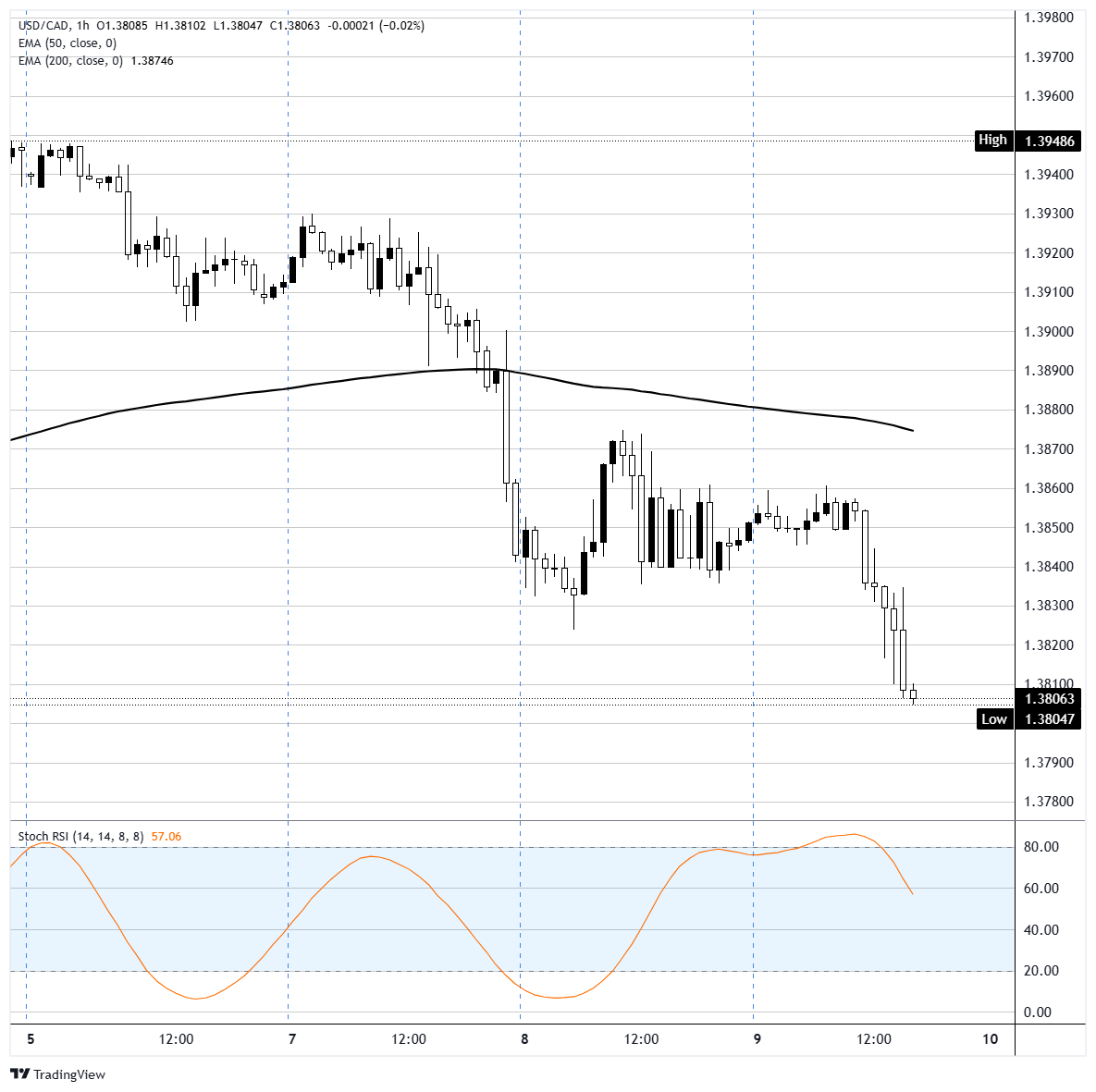
USD/CAD has shed nearly a full percent since the start of the week, sliding from the 1.3965 area to trade near the 1.3800 handle on Thursday.
x
Market Holidays Click Here

USD/CAD has shed nearly a full percent since the start of the week, sliding from the 1.3965 area to trade near the 1.3800 handle on Thursday. The move accelerated sharply on Tuesday evening after the US and Iran agreed to a Pakistan-brokered two-week ceasefire, pulling the rug out from under the Greenback's wartime safe-haven bid.
The timing was dramatic. With just hours remaining on President Donald Trump's deadline for Iran to reopen the Strait of Hormuz, Pakistan's Prime Minister Shehbaz Sharif announced that both sides had agreed to an immediate ceasefire. Trump confirmed the deal on Truth Social, calling Iran's 10-point proposal a "workable basis on which to negotiate." The announcement sent shockwaves through FX markets, with the Bloomberg Dollar Spot Index dropping as much as 1.1% on Wednesday, its steepest single-day decline since January. The Greenback fell against all 16 major peers as traders rapidly unwound one of the conflict's most crowded trades: long US Dollars.
For USD/CAD specifically, the selloff was amplified by the Oil channel. WTI plunged over 10% intraday as the prospect of Hormuz reopening flooded back into the pricing. While cheaper Oil is typically a headwind for the Canadian Dollar, the broader risk-on impulse and collapsing US Dollar more than offset any commodity drag. The loonie caught a strong bid as funds rotated out of defensive positioning.
Perhaps the most consequential shift this week has been in Federal Reserve (Fed) expectations. Before the ceasefire, markets had priced out any chance of a Fed rate cut, with traders even flirting with the possibility of a hike to combat Oil-driven inflation. That narrative flipped overnight. With Oil back below $100 and the immediate threat of an inflationary spiral receding, rate futures have begun pricing at least one cut back into the 2026 curve. Minutes from the Federal Open Market Committee's (FOMC) March meeting, released Wednesday, showed policymakers were split, with some viewing a hike as potentially necessary while others still expected a cut this year. The ambiguity is keeping the Dollar on the back foot.
The hourly chart tells the story neatly. USD/CAD peaked near 1.3965 last Friday and has been in a near-vertical decline since, breaking below the Parabolic SAR and slicing through the 1.3900 and 1.3850 levels with minimal consolidation. The RSI on the hourly timeframe dipped into oversold territory below 30 earlier this week before staging a modest recovery to the mid-40s, suggesting the initial selling impulse may be losing momentum around the 1.3800 to 1.3850 zone.
Thursday's price action suggests the easy part of the move may be done, but the hard part is just beginning. The ceasefire is already showing cracks. Iran accused the US of violating the deal after Israel continued strikes on Lebanon, while the Strait of Hormuz remains functionally closed. Oil has bounced back above $97, and the DXY has steadied near 99 as risk appetite fades. VP Vance is set to lead a US delegation to Islamabad for talks on Saturday, and traders will be watching closely to see whether the fragile truce holds or collapses.
The data calendar adds another layer of uncertainty. US March Consumer Price Index (CPI) data drops on Friday, offering the first real look at how the conflict has impacted consumer prices. A hot print could quickly revive rate hike fears and snap the Dollar back to life, while a soft number would reinforce the rate cut repricing and potentially push USD/CAD toward the 1.3750 to 1.3700 zone.
For now, the pair is stuck between a ceasefire bid and a fragile peace. The 165-pip drop this week says the market wanted this truce badly. Whether it survives the weekend is another question entirely.
The key factors driving the Canadian Dollar (CAD) are the level of interest rates set by the Bank of Canada (BoC), the price of Oil, Canada’s largest export, the health of its economy, inflation and the Trade Balance, which is the difference between the value of Canada’s exports versus its imports. Other factors include market sentiment – whether investors are taking on more risky assets (risk-on) or seeking safe-havens (risk-off) – with risk-on being CAD-positive. As its largest trading partner, the health of the US economy is also a key factor influencing the Canadian Dollar.
The Bank of Canada (BoC) has a significant influence on the Canadian Dollar by setting the level of interest rates that banks can lend to one another. This influences the level of interest rates for everyone. The main goal of the BoC is to maintain inflation at 1-3% by adjusting interest rates up or down. Relatively higher interest rates tend to be positive for the CAD. The Bank of Canada can also use quantitative easing and tightening to influence credit conditions, with the former CAD-negative and the latter CAD-positive.
The price of Oil is a key factor impacting the value of the Canadian Dollar. Petroleum is Canada’s biggest export, so Oil price tends to have an immediate impact on the CAD value. Generally, if Oil price rises CAD also goes up, as aggregate demand for the currency increases. The opposite is the case if the price of Oil falls. Higher Oil prices also tend to result in a greater likelihood of a positive Trade Balance, which is also supportive of the CAD.
While inflation had always traditionally been thought of as a negative factor for a currency since it lowers the value of money, the opposite has actually been the case in modern times with the relaxation of cross-border capital controls. Higher inflation tends to lead central banks to put up interest rates which attracts more capital inflows from global investors seeking a lucrative place to keep their money. This increases demand for the local currency, which in Canada’s case is the Canadian Dollar.
Macroeconomic data releases gauge the health of the economy and can have an impact on the Canadian Dollar. Indicators such as GDP, Manufacturing and Services PMIs, employment, and consumer sentiment surveys can all influence the direction of the CAD. A strong economy is good for the Canadian Dollar. Not only does it attract more foreign investment but it may encourage the Bank of Canada to put up interest rates, leading to a stronger currency. If economic data is weak, however, the CAD is likely to fall.
FXStreet global market news with bilingual coverage.
USD/CAD has shed nearly a full percent since the start of the week, sliding from the 1.3965 area to trade near the 1.3800 handle on Thursday.
以色列总理本杰明·内塔尼亚胡周四宣布,他已下令“尽快”启动与黎巴嫩的直接谈判,预计谈判将集中在解除真主党武装和建立两国正式和平关系上。
The GBP/USD pair advances past the 1.3400 figure on Thursday amid deteriorating risk appetite. The Middle East ceasefire seems fragile, as Israel strikes Lebanon amid the conflict with Hezbollah. At the time of writing, the pair trades at 1.3441, up 0.36%.
美國 4-Week Bill Auction: 3.56% vs前值 3.62%
Israeli Prime Minister Benjamin Netanyahu announced Thursday that he has ordered the start of direct negotiations with Lebanon "as soon as possible," with talks expected to center on disarming Hezbollah and establishing a formal peace between the two nations.
黄金(黄金/美元)周四维持区间震荡,市场密切关注中东脆弱停火的最新进展。
荷兰国际集团(ING)策略师弗朗切斯科·佩索莱、弗兰蒂谢克·塔博尔斯基和克里斯·特纳指出,在伊朗称停火被违反后,美元(USD)已趋于稳定,但仍存在重新走弱的空间。他们强调,美联储(Fed)会议纪要强化了双向风险,并为美联储预期中的鸽派重新定价留下了空间。
纽约梅隆银行策略师Geoff Yu认为,尽管美伊停火后全球风险情绪有所改善,欧洲央行(ECB)、英格兰银行(BoE)和瑞士国家银行(SNB)的欧洲利率市场仍然高估了加息次数。他指出,目前的期货定价仍远高于年初水平,并认为推迟加息甚至重新引入降息,尤其是对瑞士国家银行而言,风险回报更佳。
BNY Strategist Geoff Yu argues that European rate markets still discount too many hikes for the European Central Bank (ECB), Bank of England (BoE) and Swiss National Bank (SNB) despite an improvement in global risk sentiment following the U.S.–Iran ceasefire.